Plenty of people in London flats, Toronto condos and Berlin apartments assume serious strength training needs a garage gym. It does not. What it needs is about 2 m × 2 m (roughly 6½ ft × 6½ ft) of floor, a small amount of well-chosen equipment, and a programme built around lifts that are heavy but quiet. This guide covers the kit, the floor-friendly movements and a sample three-day split.
The kit that fits in a corner
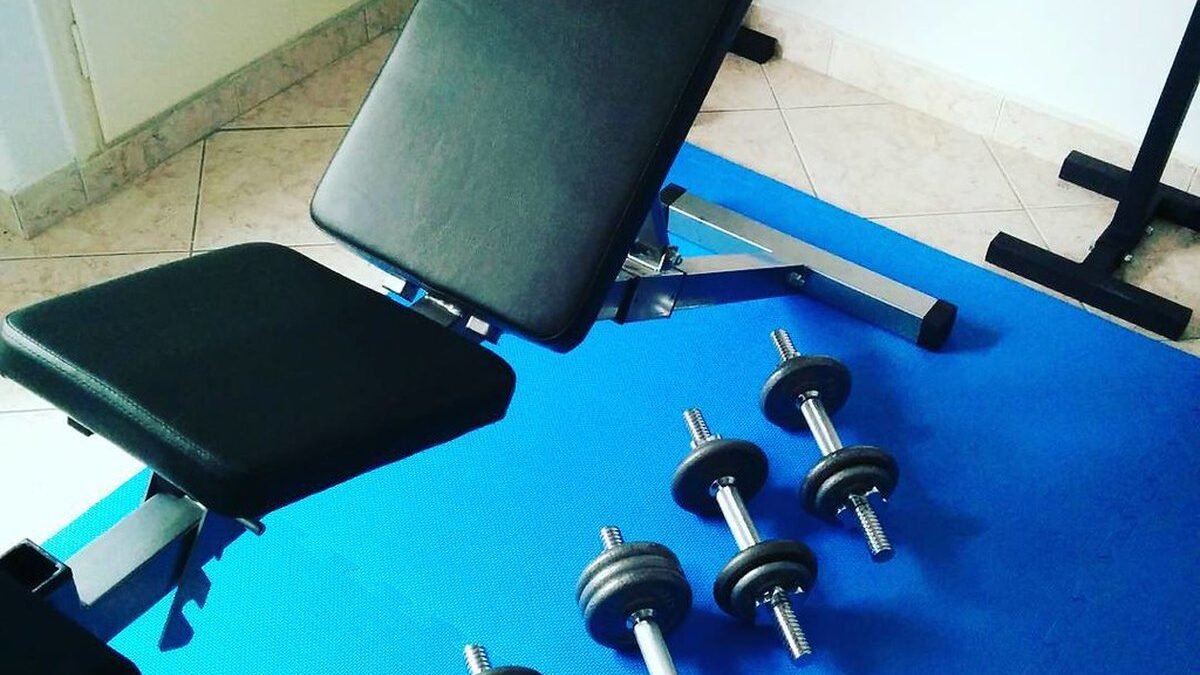
The cornerstone is a pair of adjustable dumbbells. A typical set adjusts from about 2.5 kg to 24 kg per hand (5.5–53 lb), replacing a whole rack of fixed dumbbells in the footprint of a shoebox; heavier sets reach 32.5 kg (72 lb) or 40 kg (88 lb) per hand for stronger lifters. Add a thick exercise mat — 8–15 mm (about ⅓–⅔ in) — both for comfort and to muffle contact with the floor, a set of loop resistance bands for rows and assistance work, and a sturdy chair or low box for step-ups and split squats. Everything stores in a corner or under a bed, which is the entire point.
Floor-friendly lifts that still build strength
The big patterns all have apartment-safe versions. Goblet squats and dumbbell split squats load the legs hard without a barbell. Romanian deadlifts with a slow, controlled lowering give you hinge training without ever dropping a weight — the dumbbells are set down, never released. Floor presses replace bench presses (your upper arms touching the floor is the stopping point, which also protects the shoulders). One-arm rows braced on a chair, hip thrusts with your shoulders on the sofa, and dead bugs and Pallof presses for the core complete a full-body toolkit. What to avoid: Olympic lifts, dropping deadlifts, and anything involving jumping — a dropped 20 kg (44 lb) dumbbell can crack tiles and will certainly end your downstairs neighbour’s patience.
Noise, floors and neighbours
Most apartment noise complaints about training come from impact, not effort. Three habits fix nearly all of it. First, never drop or slam weights; set everything down under control, which conveniently adds useful eccentric training. Second, train on your mat, ideally with an extra layer of interlocking foam tiles (usually sold as 60 cm / 24 in squares) in older buildings with wooden floors. Third, keep sessions inside reasonable hours — roughly 8:00 to 22:00 (8 am to 10 pm) is the norm in most leases and local rules, and heavy lower-body work is best kept out of early mornings. Jumping movements swap easily: step-ups instead of box jumps, and fast concentric goblet squats instead of jump squats.
A sample three-day split
Each session takes 40–50 minutes and uses only the kit above. Rest 60–90 seconds between sets, and leave a day between sessions.
| Day | Exercises | Sets × reps |
|---|---|---|
| Day 1 | Goblet squat; floor press; one-arm row | 4 × 6–10; 4 × 8–12; 3 × 10–12 |
| Day 2 | Romanian deadlift; split squat; band pull-apart | 4 × 8–10; 3 × 8 each leg; 3 × 15 |
| Day 3 | Hip thrust; overhead press; dead bug | 4 × 10–12; 3 × 6–10; 3 × 8 each side |
Progressing without a rack
When you reach the top of a rep range with the heaviest dumbbell you own, progression continues by other means: slow the lowering phase to three or four seconds, add a pause at the hardest point, move to harder single-leg or single-arm variations, or add reps before adding load. When you do add load, small steps work best — 1–2.5 kg (2–5 lb) at a time on the adjustable settings. Keep a simple log of weights and reps in your phone or notebook; in a small space, the logbook, not the equipment, is what makes it a real programme.